OpenSocial's First Birthday
Via  Last Thursday, the main companies behind OpenSocial and OpenSocial fans have celebrated OpenSocial's first birthday at MySpace’s San Francisco headquarters. Below is a video of the event.
Via Last Thursday, the main companies behind OpenSocial and OpenSocial fans have celebrated OpenSocial's first birthday at MySpace’s San Francisco headquarters. Below is a video of the event.
The implementation of a connectivist/LaaN-based learning system can be similar to the implementation of database systems (DBS). I don't mean that connectivist/LaaN adopts an objectivistic view of learning where knowledge is viewed as an object and as a consequence can be stored in a database. It's just that we can borrow some of the concepts used in the implementation of DBS and apply them when trying to implement a connectivist/LaaN-based approach to learning.
Let me first give a brief overview of the architecture of a DBS. More information about this architecture can be found in the following references:
- H. Garcia-Molina, J. Ullman, and J. Widom: Database Systems: The Complete Book. Prentice Hall, 2001.
- R. Ramakrishnan and J. Gehrke: Database Management Systems. 3rd Ed. McGraw-Hill, 2003.
- T. Härder, E. Rahm: Datenbankssysteme - Konzepte und Techniken der Implementierung. Springer, 1999.
A DBS consists of three main components: (1) Data System, (2) Access System, and (3) Storage System.
Data System:
The main component of the Data System is the query processor. The query processor’s task is to turn user queries into
At query compilation, the query is parsed and a parse tree for the query is generated. Then the query optimizer, which is the most important component of query compilation, first, converts the parse tree to an initial query plan, which is usually and algebraic representation of the query, and then transforms this initial plan into an equivalent plan that is expected to require less time for execution. Second, the query optimizer turns the generated equivalent plan (logical query plan) into a physical query plan by selecting algorithms to implement each of the operators of the logical plan, and by selecting an order of execution for these operators.
At query execution, the algorithms selected at the query compilation phase are executed. These algorithms fall mainly into three classes: (1) sorting-based methods, hash-based methods, and index-based methods.
Access System:
The Access System uses auxiliary structures to speed up the retrieval of records in response to certain search conditions in order to avoid scan of all pages or segments or even the whole DB. Indexes are often used in speeding up queries. The indexes commonly used in commercial DB systems are B-trees and hash tables.
Storage System:
The DB data is stored on external storage devices such as disks and fetched into main memory as needed for processing. The unit of information read from or written to disk is a page (block). The basic abstraction of data in a DBMS is a collection of records, or a file, and each file consists of one or more pages. In other words, a DB relation (table) consists of
The table below shows the analogy between a DBS and a connectivist/LaaN-based learning system.
| DBS | Connectivist/LaaN-based Learning System | Example |
| Relation | - Personal Knowledge Network (PKN); - Knowledge Ecology (KE) | - Network around an Edublogger - Network of Edubloggers |
| Record | Knowledge Node - Tacit Knowledge Node - Explicit Knowledge Node | - Edubloggers - Blog posts, videos, audios, slides produced by edubloggers |
| Index (e.g. B-tree, hash table) | - Social Network Analysis - Long Tail Aggregators and Filters | - Google Blog Search, Delicious, Digg |
| Page | Personal Knowledge Network | Network around an Edublogger |
| File | Knowledge Ecology | Network of Edubloggers |
| Disk | Collection of Knowledge Ecologies | Blogosphere, Web |

Gmail now provides voice and video chat support, as announced yesterday by Google.
Google announced yesterday a new nice feature in Google Reader: automatic feed translation.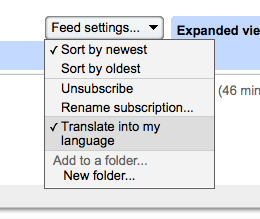
Next time you find an interesting feed in another language, just subscribe to it as normal in Reader. When you view the feed in Reader, check off "Translate into my language" in the feed settings, and (voila!) the feed will be immediately translated for you. Also, this setting will be saved so you can always view this feed in your own language.
Via Stephen Downes.
The handouts (part 1, part 2) (.pdf) of the tutorial on Collective Intelligence given by Epaminondas Kapetanios at the ACM CSTST 2008 conference.