Monday, February 07, 2011

CfPs: The PLE Conference 2011

Call for Papers: The PLE Conference 2011

http://www.pleconf.com

Following the highly successful inaugural event in Barcelona (#PLE_BCN), the next PLE Conference will be held at the University of Southampton, UK (#PLE_SOU) from July 11th to 13th 2011, and will have a lively social programme as well as a highly interactive and innovative technical programme.

The Personal Learning Environment (PLE) Conference is intended to produce a space for researchers and practitioners to exchange ideas, experience and research around the development and implementation of PLEs – including the design of environments and the sociological and educational issues that they raise. Whilst the conference includes a traditional research paper strand, we also encourage proposals for sessions in different formats including workshops, posters, debates, cafe sessions and demonstrations aiming to sustain the dynamic and interactive discussion environment established by the opening event in Barcelona in 2010.

A Personal Learning Environment (PLE) includes the tools, communities, and services that constitute individual educational platforms learners use to direct their own learning and pursue educational goals. This represents a shift away from the traditional model of learning, and towards a model where students draw connections from a growing matrix of online and offline resources that they select and organise. To gain something of the flavour of last year¹s conference search for #PLE_BCN and see http://pleconference.citilab.eu/

CALL FOR PAPERS

Deadline Saturday 26th March

The conference organisers welcome 500-800 word abstracts for full or short research papers. Submissions for other types of presentation, such as workshops, symposia, demonstrations and installations are also encouraged. These can be submitted electronically via ConfTool http://pleconf.cs.uni-paderborn.de/ . The full guidelines for submissions can be downloaded here.

Conference themes include (but are not limited to):

  • Theories and frameworks for Personal Learning Environments
  • Technologies and software for developing Personal Learning Environments
  • PLEs in Practice (case studies, approaches to using PLEs)
  • Educational institutions, change and PLEs
  • Pedagogical approaches to managing personal learning
  • The development and management of Personal Learning Networks
  • Mobile PLEs and augmented reality
  • Supporting informal and contextual learning
  • Using PLEs in organisations
  • Using PLEs for Work Based Learning
  • Mash-up PLEs
  • Presentation formats
  • Future visions: Quo vadis PLE?

The PLE conference is especially looking for originality and relevancy of ideas and for creative proposals, in both form and content. Formats for publication and communication of research are two different things! Independently of the publication format you decide to contribute, full research paper, workshop etc., the organising committee encourages interactive and creative ways of communicating research.

Hence, we invite you to submit your contribution in the publication format you prefer and select your preference regarding the type of presentation you wish to make (e.g.: round table discussion, bring your own laptop, cafe session, etc.) in the submission form. Once the review of papers is concluded, presentations will be organised by topics and session chairs will start liaising with participants regarding the organisation of their session. Our goal is to create spaces for meaningful discussions. In short, the purpose is to create opportunities for delegates to interact with each other and achieve real communication. We aim to promote dialogue and interactivity throughout the conference.

We welcome submissions and ideas for videos, photo collages, podcasts, cartoons, posters – or any other kind of artifacts you can think of. In celebration of User Generated Content we will have a Mediacast Contest during the PLE Conference 2011 with awards for the best three mediacast productions on Personal Learning Environments.

A separate call for pechakucha sessions will be released shortly.

Review Process
All proposals will be subject to a peer review process and all proposals accepted will be published electronically with an ISSN number. In addition to the proceedings, we intend to publish selected conference papers in special editions of the journals that support the conference.
Please note that all submissions should be licensed under a Creative Commons licence.

Each registered participant may submit one full or short paper contribution to the conference, although further proposals in different formats are welcome.

Deadlines
The deadline for proposals is March 26th, 2011.
You will be notified if your submission has been accepted by April 30th.
For those submitting proceedings papers, the deadline for the receipt of the full paper is May 28th.

Full Papers:
If your abstract is accepted, the full paper should be between 3000 and 5000 words. words (including references, tables and figures).

Short Papers/ Extended Abstracts:
The short paper proposals are especially designed to encourage the presentation of work in progress. Short papers should be between 1500 words and 2500 words.

Workshops, Posters, Symposia, Demonstration, Installations, BringYourOwnLaptop sessions and other Formats:
Please submit your proposal indicating that you intend to make a contribution in one of these alternative formats.

If you have any queries please do not hesitate to contact us:

Web: http://www.pleconf.com
Conference Chairs: info@pleconf.com
Programme Committee Chairs: pcchair@pleconf.com
Hashtag:#PLE_SOU

Monday, January 31, 2011

EC-TEL 2011 Call for Papers

EC-TEL 2011

Sixth European Conference on Technology Enhanced Learning

Towards Ubiquitous Learning

http://www.ec-tel.eu

20-23 September 2011, Palermo, Italy

EC-TEL is a unique setting for researchers, practitioners, and policy makers in Technology Enhanced Learning from Europe and other continents to meet together and exchange on the current challenges and advances in the field. At EC-TEL, experts and young researchers in Computer Science, Education, Psychology, Cognitive Science, and Social Science, as well as entrepreneurs have the opportunity to establish collaborations, strengthen their links and
cross-fertilize their core disciplines.

EC-TEL 2011will push further the Ubiquitous Learning paradigm by not only
tackling the challenges of exploiting new trendy devices in various contexts,
but also by investigating ways to meet and support formally and informally the learners in their learning playgrounds and social environments thanks to
innovative scenarios.

CONFERENCE TOPICS

From both research and experience perspective the following topics of interest to the conference include, but are not limited to:

Technological underpinning

  • Large scale sharing and interoperability
  • Personalization, user modeling and adaptation
  • Context-aware systems
  • Social computing
  • Social media
  • Semantic Web
  • Mobile technologies
  • Serious games and 3D virtual worlds
  • Network infrastructures and architectures for TEL
  • Sensors and sensor networks
  • Augmented reaility
  • Roomware and ubiquitous learning
  • Data mining and information retrieval
  • Recommender systems for TEL
  • Natural language processing and latent semantic analysis
  • eLearning specifications and standards
  • Learning analytics

Pedagogical underpinning

  • Problem- and project-based learning / Inquiry based learning
  • Computer supported collaborative learning
  • Collaborative knowledge building
  • Game-based and simulation-based learning
  • Story-telling and reflection-based learning
  • Instructional design and design approaches
  • Communities of learners and communities of practice
  • Teaching techniques and strategies for online learning
  • Learner motivation and engagement
  • Evaluation methods for TEL

Individual, social &organizational learning processes

  • Cognitive mechanisms in knowledge acquisition and construction
  • Self-regulated and self-directed learning
  • Reflective learning
  • Social processes in teams and communities
  • Social awareness
  • Knowledge management and organizational learning
  • Sustainability and TEL business models and cases
  • Business-learning models
  • Trust and reputation in TEL
  • Fitness and evolvability of learning environments

Learning contexts and domains

  • Applications of TEL in various domains
  • Formal education: initial (K-12, higher education), post-initial (continuing education)
  • Workplace learning in small, medium and large companies
  • Aggregated learning at the workplace Distance and online learning
  • Lifelong learning (cradle to grave)
  • Vocational training
  • Informal learning
  • Non-formal learning
  • Ubiquitous learning
  • Knowledge management

TEL in developing countries

  • ICT Inclusion for learning
  • Digital divide and learning
  • Generation divide and learning
  • Education policies
  • Rural learning

TEL, functional diversity and users with special needs

  • Accessible learning for all
  • Visual, hearing and physical impairments
  • Psycho-pedagogic support for users
  • Educational guidance for tutors
  • Adapted learning flow, content and monitoring process
  • Standards about accessibility and learning

DEMONSTRATIONS

The EC-TEL Demonstration is your chance to fully engage EC-TEL attendees at a personal level by letting them see, touch, squeeze, or hear your visions for the future of TEL. We expect that your Demonstration will be a reliably running prototype of your vision ready to be tried out, questioned, and interacted with. In particular, we encourage Demonstration submissions that complement an EC-TEL Paper submission, so that attendees can get a direct experience of your work in addition to the scientific presentation.

WORKSHOP ORGANISATION

EC-TEL 2011 offers the opportunity to host several workshops. Parties interested to organize a workshop are asked to submit a proposal of max. 4 pages outlining the theme of the workshop, workshop format, expected participants and domains addressed, dissemination activities, programme committee, and organizational requirements. A separate call will be published in parallel. Proposals should be submitted via the EasyChair system of EC-TEL.

PROJECT MEETINGS

In addition to the regular sessions and workshops, EC-TEL offers a unique
opportunity for European Projects in TEL to held face-to-face meetings. Please contact the local organization Chair at your earliest convenience to book meeting rooms.

IMPORTANT DATES

  • Paper & demonstration submission: 04 April 2011
  • Paper & demonstration acceptance: 31 May 2011
  • Camera-ready final papers: 30 June 2011
  • Workshop proposals: 04 April 2011
  • Workshop acceptance: 09 May 2011
  • Workshops: 20-21 September 2011
  • Conference: 22-23 September 2011

SUBMISSION FORMATS

All papers will be reviewed through a non-blind review process. Accepted papers will be published in the conference proceedings. Proceedings will be published by Springer within their “Lecture Notes in Computer Science” series which is ranked in the ISI Web of Knowledge. The use of supplied template is mandatory:
http://www.springer.com/computer/lncs?SGWID=0-164-7-72376-0

  • Full Papers (max. 14 pages)
  • Short Papers and Posters (max. 6 pages)

CONFERENCE ORGANISATION

  • General Chair: Martin Wolpers, Fraunhofer FIT, Germany
  • Programme Chairs: Carlos Delgado Kloos, eMadrid/TELSpain/University Carlos III of Madrid, Spain; and Denis Gillet, Ecole Polytechnique Fédérale de Lausanne (EPFL), Switzerland
  • Workshop Chair: Stefanie Lindstaedt, Know-Center Graz, Austria
  • Poster and Demonstration Chair: Fridolin Wild, The Open University, UK
  • Dissemination Chair: Abelardo Pardo, eMadrid/TELSpain/University Carlos III of Madrid, Spain
  • Local Organization Chair: Mario Allegra, Istituto per le Tecnologie Didattiche, Italy
  • Doctoral Consortium Chairs: Katherine Maillet, Télécom SudParis, France; and Mike Sharples, University of Birmingham, UK

Tuesday, January 18, 2011

The 3P Learning Model

The paper "The 3P Learning Model" has been published in the Journal of Educational Technology and Society (Vol. 13, Issue 4). The paper can be downloaded here.

Abstract:

Recognizing the failures of traditional Technology Enhanced Learning (TEL) initiatives to achieve performance improvement, we need to rethink how we design new TEL models that can respond to the learning requirements of the 21st century and mirror the characteristics of knowledge and learning which are fundamentally personal, social, distributed, ubiquitous, flexible, dynamic, and complex in nature. In this paper, we discuss the 3P learning model; a vision of learning characterized by the convergence of lifelong, informal, and personalized learning within a social context. The 3P learning model encompasses three core elements: Personalization, Participation, and Knowledge-Pull. We then present the social software supported learning framework as a framework that illustrates the 3P learning model in action, based on Web 2.0 concepts and social software technologies.

Reference:

Chatti, M. A., Jarke, M. & Specht, M. (2010). The 3P Learning Model. Educational Technology & Society, 13(4), 74-85.

Monday, January 10, 2011

News


After finishing my PhD at Informatik 5 (the Informations Systems group at RWTH Aachen University), I joined Informatik 9 (the eLearning group at RWTH Aachen University). See my new homepage there.

Thursday, December 23, 2010

Dissertation


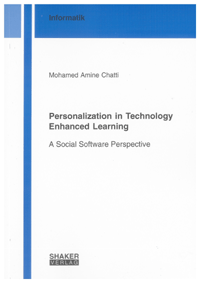
My dissertation Personalization in Technology Enhanced Learning: A Social Software Perspective has been published by Shaker Verlag, Germany.