New Tools for Personal Learning
A nice presentation by Stephen Downes who talked about tools for personal learning, at the MEFANET 2009 conference. Slides and audio from this talk are available.
A nice presentation by Stephen Downes who talked about tools for personal learning, at the MEFANET 2009 conference. Slides and audio from this talk are available.
Call for articles of the
International Journal for TEL
for a special issue on
'Mash-Up Personal Learning Environments'
Submission deadline: January 8th, 2010
The International Journal of Technology Enhanced Learning (IJTEL)
seeks original manuscripts for a Special Issue on Mash-Up
Personal Learning Environments to appear in 2010.
A change in perspective can be certified in the recent years
to technology-enhanced learning re-search and development: More
and more learning applications on the web are putting the learner
centre stage, not the organisation. They empower learners with
capabilities to customize and even construct their own personal
learning environments (PLEs). These PLEs typically consist of
distributed web-applications and services that support system-
spanning collaborative and individual learning activities in
formal as well as informal settings.
Technologically speaking, this shift manifests in a learning
web where information is distributed across sites and activities
can easily encompass the use of a greater number of pages and
services offered through web-based learning applications. Mash-ups,
the 'frankensteining' of software arte-facts and data, have
emerged to be the software development approach for these
long-tail and per-petual-beta niche markets. Core technologies
facilitating this paradigm shift are Ajax, javascript-based
widget-collections, and microformats that help to glue together
public web APIs in individual applications.
The International Journal of Technology Enhanced Learning
(IJTEL) dedicates a focused issue on col-lecting the research
on understanding and engineering mash-up personal learning
environments.
TOPICS:
- Visions: architectures, frameworks, strategies, models
- (Collaborative) authoring tools
- Data interoperability: with e.g. microformats, streaming
data, mixed media data
- User interfaces: concepts, metaphors, workflows
- Development methodologies
- Innovative widgets and services: e.g. for instruction,
reflection, personal information
- Interoperability standards for e.g. content recombination
or PLE configuration
- User studies & evaluation methods: evaluating e.g. performance
- Usability, specific design features, training methods
IJTEL fosters multidisciplinary discussion and research on
technology enhanced learning (TEL) ap-proaches at the
individual, organisational, national and global levels.
Its key objective is to be the leading scholarly scientific
journal for all those interested in, researching and
contributing to the technology enhanced learning episteme.
For this reason, IJTEL delivers research articles, position
papers, surveys and case studies aiming:
- Provide a holistic and multidisciplinary discussion
on technology enhanced learning research issues
- Promote international collaboration and exchange of
ideas and know how on technology enhanced learning
- Investigate strategies on how technology enhanced
learning can promote sustainable development
Papers submitted to this special issue must follow the criteria
used by IJTEL and defined by the na-ture of this special issue,
namely by covering the following mandatory items:
- Presenting original research;
- Offering a critical review of the state of the art in the field;
- Providing methodologically sound and innovative
technological insights;
- Illustrating the application in real-world cases;
- Performing the evaluation of the proposed ideas.
Submitted articles must not have been previously published or
be currently submitted for journal publication elsewhere. As
an author, you are responsible for understanding and adhering
to our submission guidelines. You can access them at
http://www.inderscience.com/mapper.php?id=31
The journal is now accepting submissions for this special issue
through its Online Submissions and Peer-Review System at
http://www.inderscience.com/papers, which provides instructions
about formatting and length. If you have any questions,
please contact submissions@inderscience.com or the guest
editors at the addresses listed below. Please include the title
of the Journal in your email and give as much detail as possible
about your query or problem.
IMPORTANT DATES
- Paper Submission: January 8th, 2010
- Results Notification: February 8th, 2010
- Revisions: March 8th, 2010
- Notification of Final Acceptance: March 21st, 2010
- Final versions: April 21st, 2010
BOARD OF REVIEWERS
- Abelardo Pardo (University Carlos III de Madrid, Spain)
- Dai Griffith (University of Bolton, UK)
- Denis Gillet (EPFL, Switzerland)
- Effie Law (University of Leicester, United Kingdom)
- Felix Mödritscher (Vienna University of Economics
and Business, Austria)
- Graham Atwell (Pontydysgu, United Kingdom)
- Gytis Cibulskis (Kaunas Technical University, Lithuania)
- Mart Laanpere (Tallinn University, Estonia)
- Martin Wolpers (Fraunhofer FIT, Germany)
- Mohamed Amine Chatti (RWTH Aachen, Germany)
- Ralf Klamma (RWTH Aachen, Germany)
- Nikos Karacapilidis (University of Patras, Greece)
- Scott Wilson (University of Bolton, United Kingdom)
- Stéphane Sire (EPFL, Switzerland)
- Tony Hirst (Open University, UK)
- Ernie Ghiglione (Macquarie University, AU)
(GUEST) EDITORS
- Fridolin Wild (The Open University, UK)
- Matthias Palmer (University of Upsala, Sweden)
- Marco Kalz (Open University, The Netherlands)
Via Stan Schroeder.
Today, we’re excited to introduce a new feature to our website that will expose the niche add-ons that can be hard to find, and gives users a more active role in helping outstanding add-ons bubble to the top.
Below is the CfP for the 2nd workshop on Mash-Up Personal Learning Environments (MUPPLE’09). The same workshop last year was a great success. Please do consider submitting a paper to this very interesting workshop. Looking forward to seeing many of you there!
2nd Workshop onMash-UP Personal Learning Environments (MUPPLE-09) Interoperable Widgets, Services, and Microformats to facilitate Competence Development held at the 4th European Conference on Technology Enhanced Learning (EC-TEL09), Nice, France, September 29 - October 2, 2009 RATIONALE A change in perspective can be certified in the recent These PLEs typically consist of distributed web- |
Consequently, the aim of this workshop is not to discuss the
concepts ‘PLE vs. LMS’, but to focus more generally on how learning
experiences can be enriched using mash-ups of widgets and services
with microformats and how technology can help to respond automatically
to competence level, need, or context. Moreover, the investigation
of necessary competencies to deploy mash-up technologies, is
dedicated special attention in this workshop.
Technologically speaking, this shift manifests in a learning
web where information is distributed across sites and
activities can easily encompass the use of a greater number
of pages and services offered through web-based learning
applications. Mash-ups, the ‘frankensteining’ of software
artefacts and data, have emerged to be the software
development approach for these long-tail and perpetual-beta
niche markets. Core technologies facilitating this paradigm
shift are Ajax, javascript-based widget-collections, and
microformats that help to glue together public web APIs
in individual applications. Interoperability is the enabler
to allow these different components to be worked
together facilitating the achievement of the underlying
learning task.
In a wide range of European IST-funded research projects
such as ROLE, iCoper, Stellar, LTfLL, Mature, Palette, OpenScout,
and TENcompetence a rising passion for these technologies
can be identified.
This workshop therefore serves as a forum to bring together
researchers and developers from these projects and an open
public that have an interest in understanding and engineering
mash-up personal learning environments (MUPPLEs).
TOPICS OF INTEREST (but not limited to):
WORKSHOP FORMAT
The aim of this workshop is to bring together the various research
and development groups in technology-enhanced learning that currently
focus on the development of the next generation learning environments –
learning environments that put the individuum centre stage and empower
learners with design capabilities by deploying modern mash-up principles
to establish system-spanning interoperability.
As this approach is rather young, the workshop seeks to attract
both research results and work in progress in order to chart out
the current state-of-the-art of MUPPLEs in TEL and to define
main enablers and future challenges. Naturally, it will serve
as a forum for establishing new collaborations.
Using the presentations as impulses and continuing post-talk
debates, the workshop will conclude the day with an open discussion
exchanging ideas, summing up, and defining a medium- to
long-term research agenda.
SUBMISSIONS
Authors are invited to submit original unpublished research as full
papers (8 pages), work-in-progress as short papers (max. 4 pages) or
position statements (max. 2 pages). All submitted papers will be peer-
reviewed by at least three members of the program committee for
originality, significance, clarity, and quality.
The workshop proceedings will be published online as part of the
CEUR Workshop proceedings series. http://CEUR-WS.org is a recognized
ISSN publication series, with ISSN 1613-0073.
Furthermore, the workshop serves as stage for presenting
a snapshot of the work on contributions planned to be submitted
to the upcoming special issue on mash-up personal learning
environments in the International Journal of Technology Enhanced Learning (IJTEL,
http://www.inderscience.com/browse/index.php?journalCODE=ijtel).
Authors should use the Springer LNCS format (http://www.springer.com/
lncs). For camera-ready format instructions, please see “For Authors”
instructions at http://www.springer.de/comp/lncs/authors.html.
All questions and submissions should be sent to:
f.wild @ open.ac.uk
IMPORTANT DATES
PROGRAMME COMMITTEE
ORGANISERS
ABOUT EC-TEL09
After three successful EC-TEL conferences in 2006, 2007, and 2008,
the Fourth European Conference on Technology Enhanced Learning
provides a unique forum for all research related to TEL, among
them education, psychology, and computer science. The contributions
will cover the design of innovative environments, the implementation
of new technological solutions, results of empirical studies on
socio-cognitive processes in learning, and field studies regarding
the use of technologies in context.
EC-TEL is a competitive and broad forum for TEL research in Europe
and beyond. In its specialised accompanying workshops and the
highlighting main conference programme, EC-TEL09 provides
unique networking possibilities for participating researchers
throughout the week and includes project meetings and discussions
for ongoing and new research activities supported by the European
Commission. See http://www.ectel09.org/ for details.
At Google I/O, Google announed Google Web Elements, a set of widgets that allow users to quickly integrate some of Google’s most popular products (e.g. Calendar, Maps, News) directly into their sites with a minimal amount of effort. Above is a News element (widget), searching for news on Sports.
 A PLE is a learner's gate to knowledge. It can be viewed as a self-defined collection of services, tools, and devices that help learners build their Personal Knowledge Networks (PKN), encompassing tacit knowledge nodes (i.e. people) and explicit knowledge nodes (i.e information). Thus, mechanisms that support learners in building their PLEs become crucial.

In contrast to traditional LMS-driven e-learning solutions, a Personal Learning Environment (PLE) takes a more natural and learner-centric approach and is characterized by the freeform use of a set of lightweight services and tools that belong to and are controlled by individual learners. Rather than integrating different services into a centralized system, the idea is to provide the learner with a plethora of different services and hand over control to her to select, use, and mashup the services the way she deems fit. A PLE driven approach does not only provide personal spaces, which belong to and are controlled by the user, but also requires a social context by offering means to connect with other personal spaces for effective knowledge sharing and collaborative knowledge creation (Chatti et al., 2007).
The Personal Learning Environment Framework (PLEF) supports the learners in taking control over their learning experience by aggregating, managing, tagging, commenting, and sharing their favorite resources (e.g. feeds, widgets, and different media) within a personalized space. PLEF differs from popular personalized start pages such as iGoogle, My Yahoo, Netvibes, or Pageflakes mainly in six important points:
I'm back from a 3 weeks holiday in lovely Tunisia. My first post after this break will be to announce the call for participation and the programme for the interesting MUPPLE08 Workshop where I'm member of the programme committee.
PROGRAMME:
09:00 Welcome Message & Keynote (t.b.a.)
09:40 Felix Mödritscher, Fridolin Wild, Steinn Sigurdarson:
Language Design for a Personal Learning Environment Design
Language (Long Paper)
10:10 Juan I. Asensio-Perez, Miguel L. Bote-Lorenzo,
Guillermo Vega-Gorgojo, Yannis A. Dimitriadis, Eduardo Gomez-Sanchez,
Eloy D. Villasclaras-Fernandez: Adding mash-up based tailorability
to VLEs for scripted Collaborative Learning (Short Paper)
10:30 Luis de la Fuente Valentín, Derick Leony, Abelardo Pardo,
Carlos Delgado Kloos: Mashups in Learning Design: pushing the flexibility
envelope (Long Paper)
- 10 min break -
11:10 Scott Wilson, Paul Sharples, Dai Griffiths:
Distributing education services to personal and institutional systems
using Widgets (Long Paper)
11:40 Stéphane Sire, Alain Vagner: Increasing Widgets Interoperability at the
Portal Level (Short Paper)
12:00 Oskar Casquero, Javier Portillo, Ramón Ovelar, Jesús Romo, Manuel Benito:
iGoogle and gadgets as a platform for integrating institutional and external
services (Short Paper)
12:20 Evgeny Bogdanov, Christophe Salzmann, Sandy El Helou, Denis Gillet:
Social Software Modeling and Mashup based on Actors, Activities and Assets
(Short Paper)
- lunch break -
13:30 Hannes Ebner, Matthias Palmer:
A Mashup-friendly Resource and Metadata Management Framework (Long Paper)
14:00 Ahmet Soylu, Selahattin Kuru, Fridolin Wild, Felix Mödritscher:
A Learning Object Harvesting Model and a Sample Application (Long Paper)
14:30 Riina Vuorikari:
A case study on teachers’ use of social tagging tools to create collections of
resources - and how to consolidate them (Short Paper)
- 10 min break -
15:00 Sebastian Weber, Ludger Thomas, Eric Ras:
Investigating the Suitability of Mashups for Informal Learning and Personal
Knowledge Management (Long Paper)
15:30 Graham Attwell: Maturing learning: Mash up Personal Learning Environments
(Long Paper)
- 10 min break -
16:10 Problem Sharing: Future Challenges (open discussion)
17:00 end (s.t.)

Yesterday, Google announced the preview release of Google Friend Connect at Campfire One. "Google Friend Connect enables webmasters to quickly and easily enhance their site with community features; what's more, these features leverage visitors' existing social ties. By simply copying and pasting a few lines of JavaScript, you can implement the social functionality you want, and visitors can connect with their Facebook, orkut and other friends directly on your website."
Here's a video from Campfire One introducing Friend Connect.
From a press release on May 12:
Websites that are not social networks may still want to be social -- and now they can be, easily. With Google Friend Connect (see http://www.google.com/friendconnect following this evening's Campfire One), any website owner can add a snippet of code to his or her site and get social features up and running immediately without programming -- picking and choosing from built-in functionality like user registration, invitations, members gallery, message posting, and reviews, as well as third-party applications built by the OpenSocial developer community.
Visitors to any site using Google Friend Connect will be able to see, invite, and interact with new friends, or, using secure authorization APIs, with existing friends from social sites on the web, including Facebook, Google Talk, hi5, orkut, Plaxo, and more.
"Google Friend Connect is about helping the 'long tail' of sites become more social," said David Glazer, a director of engineering at Google. "Many sites aren't explicitly social and don't necessarily want to be social networks, but they still benefit from letting their visitors interact with each other. That used to be hard. Fortunately, there's an emerging wave of social standards -- OpenID, OAuth, OpenSocial, and the data access APIs published by Facebook, Google, MySpace, and others. Google Friend Connect builds on these standards to let people easily connect with their friends, wherever they are on the web, making 'any app, any site, any friends' a reality."
A nice post by Dion Hinchcliffe on the shift from Service-Oriented Architecture (SOA) to Web-Oriented Architecture (WOA).

This API iteration represents significant enhancements to 0.6; in particular, viral-spread functions and activity stream templating have been introduced to support the needs of app developers. In addition, the gadgets specification and the emerging gadgets.* JavaScript API have been codified, and include details about letting containers cleanly support different views (e.g. profile or canvas).
GWT Ext 2.0 has been released with several new changes and widgets.
Demo : http://www.gwt-ext.com/demo
Project Site : http://www.gwt-ext.com/
Release Notes : http://gwt-ext.com/release_notes.html
GWT-Ext is a powerful widget library that provides rich widgets like Grid with sort, paging and filtering, Tree’s with Drag & Drop support, highly customizable ComboBoxes, Tab Panels, Menus & Toolbars, Dialogs, Forms and a lot more right out of the box with a powerful and easy to use API. It uses GWT and Ext.
has written a nice introduction on the Google Gadget API and how to write a gadget, targeted at developers who already know Ajax. To define gadgets, the author writes:
- The gadget is an XML file sitting on your server. In my case, http://ajaxify.com/run/widgets/google/diggroundup.xml. It will get cached, so effectively it must be a static file.
- The user adds your gadget to their igoogle portal, or codes it into their own website, by specifying this URL (it may be done indirectly - via the gadget registry. You'll appear in the registry if you've submitted your gadget to igoogle.)
- The gadget is rendered as an iframe, so you have all the usual security constraints which stop you borking the portal and other gadgets. This also means you can't communicate with other Gadgets other than via than remote calls to a common third-party server (or has anyone tried hooking them together using the iframe-fragment identifier hack? )
A nice post by David Lenehan on Widgets.
A Web widget can be best described as a mini application that can add functionality to your web page, blog, social profile etc. If you find a widget that you like, you simply copy and paste some code and add it to the HTML of your web page. Photo galleries, news, videos, advertising, mp3 players and pregnancy countdown tickers! You name it, there is probably a widget that does it.
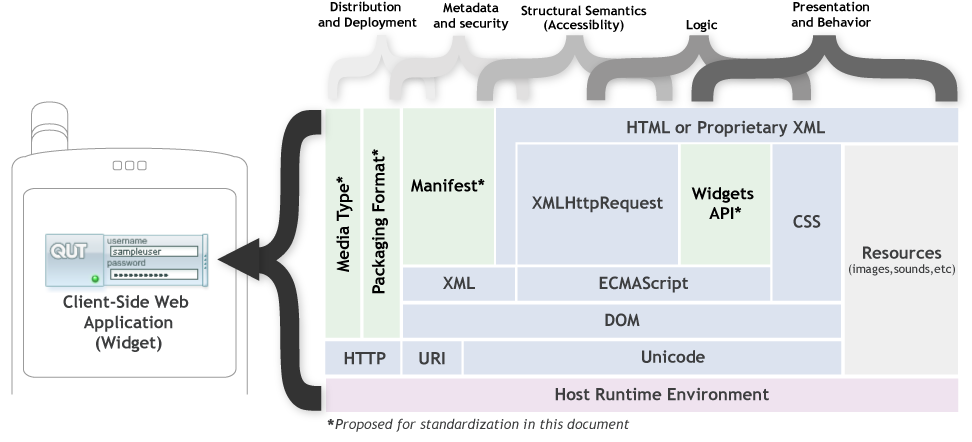
Scott Wilson and Stephen Downes pointed to W3C´s attempts to standardize Widgets. W3C defines widgets as typically self-contained applications for displaying and updating remote data, packaged in a way to allow a single download and installation on a client machine or mobile device. Below is the architecture of a typical widget according to W3C.